
Signs of Hail Damage on a Roof That Most Homeowners Miss
North Texas takes a beating every storm season, and Bedford sits right in the path. The problem is that most hail damage does not look like damage from the driveway. Shingles stay flat, the roof still looks clean, and water quietly works its way toward the decking. Insurance adjusters call this functional damage, and homeowners walk past it for years without a second thought. Missing it costs money twice: once when the claim window closes, and again when the roof fails a decade early. Knowing exactly what to look for after a storm changes the entire outcome.
What Hidden Signs of Hail Damage on a Roof Look Like Up Close
Hail rarely punches a hole through an asphalt shingle. It bruises, strips, and fractures instead, and every one of those failures happens on a scale you cannot judge from ground level. A roof can lose thousands of granules in a single storm and still look normal from the street. The damage shows up later as accelerated aging, brittle shingles, and leaks that appear during the next heavy rain. Soft metals around the roof tell the real story, because they hold a dent permanently. Reading those three clues together gives you an honest picture of what the storm actually did.
Granule Loss Is the First Sign of Hail Damage on a Roof
The colored granules on an asphalt shingle are not decoration. They shield the asphalt layer underneath from ultraviolet light, and they carry the fire rating for the shingle. Hail knocks them loose on impact, and gravity carries them straight into your gutters. Check the bottom of your downspouts, the splash blocks, and the flower beds below the roof edge. A thin scattering of granules is normal on a new roof during the first season. A concentrated pile that shows up right after a storm is not. Volume and timing separate ordinary shedding from real impact damage.
On the roof itself, granule loss reads as dark spots against a lighter field. Those spots are exposed asphalt, and they often look slightly shiny in direct sun. Once that asphalt is uncovered, ultraviolet exposure starts breaking it down immediately. The shingle dries out, loses flexibility, and begins to crack years ahead of schedule. This is why a roof that survived a storm can suddenly start leaking three summers later. The storm did not cause the leak; it started a clock. Homeowners who wait for water stains have already lost most of the useful life of the roof.
Standing in your yard, you can safely check several things without ever climbing a ladder. Look inside the gutters if they are reachable from a low deck or a second story window. Scan the concrete below each downspout for granule buildup. Watch for streaking on the shingles where granules have washed down in visible tracks. None of this confirms a claim on its own, but it tells you a professional inspection is worth scheduling. Roof surfaces are slick and steep, and a fall does far more damage than the hail did. Leave the actual walk to someone with the training and the equipment.
Shingle Bruising Is the Sign of Hail Damage on a Roof That Hides Best
Bruising is the single most overlooked form of hail damage in the trade. A hailstone strikes the shingle hard enough to fracture the fiberglass mat underneath without breaking the surface. Press on that spot and it gives slightly, much like a bruised apple. Photographs rarely capture it, and it is nearly invisible from more than a few feet away. The mat is the structural backbone of the shingle, so a fracture there means the shingle has already failed. It simply has not finished failing yet.
Time turns a bruise into a hole. Every heating and cooling cycle flexes the shingle, and the fracture line opens a little wider each season. Texas summers push roof surface temperatures well past 150 degrees, then thunderstorms cool them fast. That cycle repeats hundreds of times per year on a Bedford roof. Eventually the bruise separates, the granules around it shed, and water reaches the underlayment. From the attic, this shows as a small dark ring on the decking long before anything drips onto a ceiling. Catching it during the claim period is the difference between a covered replacement and an out of pocket one.
Professional inspectors document bruising using a method insurance carriers recognize. A test square is marked out on each slope, usually a 10 by 10 foot section, and every impact inside it gets counted and chalked. Carriers commonly look for a threshold number of hits within that square before approving a slope. Each roof face gets tested separately, because storms hit slopes unevenly depending on wind direction. The report includes photos, chalk marks, slope measurements, and the direction of impact. That documentation is what an adjuster actually reviews. A homeowner walking the roof with a phone camera rarely produces anything a carrier will act on.
Soft Metal Dents Confirm Signs of Hail Damage on a Roof
Metal does not bounce back. Gutters, downspouts, drip edge, gutter apron, turbine vents, turtle vents, and pipe boot collars all record hail impacts permanently. Run your hand along the top rail of a gutter and feel for shallow dimples. Look at the vertical faces of downspouts where hail came in at an angle. Vent hoods dent easily and sit high enough to catch hail from any direction. These marks give an inspector the size of the stones and the direction they traveled. That data then explains which roof slopes should show the heaviest damage.
Collateral damage around the property matters just as much. Check the fins on your air conditioning condenser for flattened sections. Look at window screens for punctures and stretched mesh, garage doors for dimpling across the flat panels, and wood fence caps for fresh divots. Mailboxes, deck railings, patio furniture, and painted trim all hold evidence. Adjusters use these items to confirm that hail of a certain size actually fell on your address. When the roof evidence is subtle, the collateral evidence carries the claim.
Size determines severity, and the trade uses fairly consistent thresholds. Stones around one inch in diameter, roughly the size of a quarter, generally begin causing functional damage to asphalt shingles. Smaller hail driven by high wind can still damage older or brittle roofs. Roofs past 12 or 15 years old take damage from stones that would bounce harmlessly off a newer system. Metal dents also help date the storm, which matters because carriers tie coverage to a specific date of loss. Bedford has seen multiple hail events in recent seasons, and sorting old damage from new is part of a proper inspection. Getting that date right protects the claim from being denied as wear and tear.
Where Signs of Hail Damage on a Roof Get Missed Most Often
Damage concentrates in predictable places, and those places happen to be the hardest ones to see. The peak of the roof, the metal penetrations, and the underside of the decking hold most of the evidence a homeowner never checks. Front slopes visible from the street often look fine while the back slope took the full storm. Wind direction decides which faces get hit, so a one sided inspection misses the point entirely. Every slope needs its own review, along with the attic below it. These three areas account for the majority of missed hail claims in the Metroplex.
Ridge Caps and Hips Hide Signs of Hail Damage on a Roof
Ridge caps sit at the highest and most exposed point of the entire roof. They are bent over a sharp angle, which stretches the mat and thins the material at the fold. That stress makes them the first component to crack under impact. A hailstone that only bruises a field shingle can split a ridge cap cleanly in half. From the ground, the ridge line still reads as a straight, uninterrupted edge. You would need to be standing on the roof to see the cracks.
Hip lines have the same problem and add another one. Water runs off both directions from a hip, so any crack there sheds water into the seam instead of down the slope. Damaged hip caps also break the sealant strip that holds the next course down, which leaves the whole run vulnerable to wind uplift. One strong Texas storm can then peel a section of caps completely off. At that point what started as hail damage looks like wind damage, and the claim gets complicated. Documenting the original impacts early keeps the cause of loss clear.
Ridge vents deserve their own look. Many Bedford homes use a continuous ridge vent covered by cap shingles, and the plastic or composite baffle underneath cracks under hail. A cracked baffle lets wind driven rain enter the attic directly at the peak. Homeowners then find damp insulation along the center of the attic and blame condensation. The actual cause is a hail damaged vent that nobody inspected. Replacing a compromised ridge vent during a covered claim costs far less than repairing months of moisture damage to the decking.
Vents, Flashing, and Skylights Show Signs of Hail Damage on a Roof
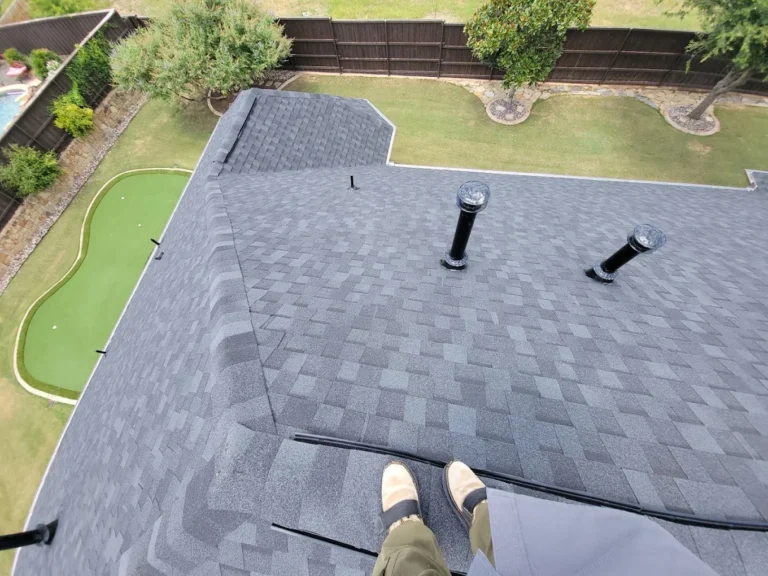
Every penetration through the roof deck is a potential entry point, and hail targets them all. Turbine vents bend at the base and lose their spin, which shuts down attic ventilation. Turtle vents crack across the hood or pull loose from their sealant. Plumbing pipe boots take direct hits that split the rubber collar, and split boots are one of the most common leak sources in North Texas. These parts are small, cheap, and almost never checked by a homeowner. They also sit far enough from the roof edge that they are invisible from any window.
Flashing does the quiet work of keeping water out of the tricky spots. Chimney flashing, step flashing along walls, and valley metal all rely on tight seals and clean bends. Hail dents the metal, breaks the sealant bead, and lifts the counterflashing away from the masonry. Water then travels behind the flashing and into the wall cavity, where it can run for feet before showing up inside. A stain on a living room ceiling ten feet from the chimney often traces back to a single damaged flashing joint. Inspectors check these seams by hand because a photo from a drone will not show a broken seal.
Skylights combine glass, metal, and sealant in one assembly, which makes them especially vulnerable. Acrylic domes craze or crack under impact, and the cracks are hard to see against a bright sky. Aluminum frames dent along the top edge where hail lands hardest. The flashing kit around the curb loosens the same way chimney flashing does. Many homeowners only discover the damage when condensation appears between the panes or water drips down the light shaft. A storm inspection should always include a close review of every skylight on the property.
Attic and Interior Clues Reveal Signs of Hail Damage on a Roof
The attic gives you a view of the roof from the inside, and it costs nothing to check. Bring a bright flashlight and look at the underside of the decking, especially along the ridge, in the valleys, and around every penetration. Fresh water intrusion shows as dark rings or streaks on the wood. Rusted nail shanks poking through the decking indicate repeated moisture exposure. Daylight visible through the deck means something above has already failed completely. Any of these findings justifies an immediate professional inspection.
Insulation tells the same story in a different way. Wet or compressed batts under a specific section of roof point directly to a leak above that spot. Blown insulation develops dark, matted patches where water has been landing. A musty smell in an attic that used to smell like dust is another signal. Mold growth on rafters or decking follows within weeks of steady moisture. Texas heat speeds all of this up, so a small leak becomes a real problem fast.
Inside the living space, the clues arrive late but they are unmistakable. Ceiling stains, bubbling paint, sagging drywall tape, and popped fasteners all indicate water that has already traveled a long way. Discoloration around recessed lights and bath fans often means the leak followed a wire or a duct before dropping. By the time these appear, the original hail event may be a year or more in the past. That delay is exactly why carriers deny claims, and exactly why post storm inspections matter. Checking the attic twice a year takes fifteen minutes and prevents most of these outcomes.
Why You Need a Professional Inspection for Signs of Hail Damage on a Roof
Hail damage is a documentation problem as much as a repair problem. Carriers approve claims based on evidence gathered correctly, dated accurately, and presented in a format they recognize. Homeowners who file without that evidence get partial approvals or flat denials. A qualified roofing contractor walks every slope, tests every face, photographs every impact, and ties the findings to a specific storm date. That report becomes the foundation of the claim. Getting it done early, before the next storm muddies the timeline, protects everything that follows.
A Free Inspection Documents Every Sign of Hail Damage on a Roof
A proper hail inspection covers the full roof system, not just the slope facing the street. Each face gets its own test square, its own hit count, and its own set of photographs. Soft metals, vents, flashing, skylights, gutters, and collateral property damage all go into the report. The attic gets checked from the inside for active intrusion. What you receive is a clear document showing what the storm did and what it will cost to correct.
That report also protects you when nothing is wrong. Plenty of Bedford roofs come through a hail event with no functional damage at all, and an honest inspection says exactly that. Knowing your roof is sound is worth having on file for the next storm. It also establishes a baseline, so future damage is easy to distinguish from existing wear. Filing a claim with no supporting evidence can work against you at renewal time. Good information leads to good decisions in both directions.
Free estimates remove the reason most homeowners wait. There is no cost to find out and no obligation attached to the answer. The inspection happens on your schedule, and the findings get explained in plain language before any paperwork starts. If repairs or a replacement make sense, you get real numbers and real options. If they do not, you get peace of mind and a written record.
Acting Fast Protects Your Claim for Signs of Hail Damage on a Roof
Insurance policies require prompt notice of a loss, and that language has teeth. The longer the gap between the storm and the claim, the harder it becomes to prove when the damage occurred. Carriers regularly deny late claims by attributing the damage to normal wear. Texas law also places limits on how long a policyholder has to pursue a disputed claim in court. Waiting removes options that cost nothing to preserve.
Many Texas policies now carry a separate wind and hail deductible calculated as a percentage of your dwelling coverage rather than a flat dollar amount. That percentage can turn into a significant number on a typical Bedford home. Understanding your deductible before filing helps you decide how to proceed. A contractor experienced with claims can walk you through the policy language and the likely scope. Clear expectations up front prevent unpleasant surprises after the adjuster leaves.
Repairs also get harder to schedule after a major hail event moves through the Metroplex. Demand spikes, materials tighten, and out of state crews flood the area for a few months and then disappear. Homeowners who move early get better scheduling and work backed by a company that will still be here in five years. Storm chasers leave; local warranties only matter if the company answers the phone. Acting quickly puts you in front of the rush instead of behind it.
Why Choose TM Roofing & Construction Group for Signs of Hail Damage on a Roof
TM Roofing & Construction Group is locally owned and operated, based at 1301 Schumac Ln in Bedford, Texas. More than 600 Facebook reviews and BBB accreditation back the work, and both are easy to verify before you ever call. Every project carries lifetime manufacturer warranties on materials and a 10 year workmanship guarantee on the installation. Our team specializes in insurance claims and knows how carriers evaluate hail damage in Tarrant County. We treat your home the way we treat our own.
Storms do not keep business hours, so we are available 24/7 with free estimates. Flexible financing is available for homeowners handling repairs outside of a claim, and we offer $500 toward your deductible. You get straight answers about what your roof needs and what it does not. No pressure, no inflated scope, no vanishing crews. That is what accountability looks like in this trade.
Reach us at (817) 820-9596 or tmconstructiongroup@mail.com to schedule an inspection. We will walk every slope, document what we find, and explain your options clearly. Hail damage does not repair itself, and it does not stay hidden forever. Finding it now costs nothing; finding it later costs a roof. Call today and get a definitive answer about the condition of yours.