What Causes Vinyl Siding to Warp and Buckle in Summer Heat
Vinyl siding is one of the most durable exterior products a North Texas home can wear, but it is not immune to what a July afternoon in Bedford does to a wall. Homeowners across Tarrant and Denton counties start noticing the same thing every summer: panels that ripple like water, sections that bow outward near a window, or a stretch of wall that suddenly looks wavy in late afternoon light. Vinyl is a plastic product, and plastic moves when it gets hot. That movement is normal and expected; the buckling you see is what happens when that movement has nowhere to go. Heat alone rarely ruins a wall. Heat plus a tight nail, a missing expansion gap, or a beam of concentrated sunlight bouncing off a neighbor’s window is what turns a healthy panel into a permanent wave. Understanding the difference matters, because one problem is fixed with a fastener adjustment and the other requires new material. Below is a plain look at why vinyl siding warps in summer heat, what the damage actually tells you, and how to keep a wall flat through a Texas August.
Why Summer Heat Makes Vinyl Siding Warp and Buckle
Vinyl siding expands and contracts constantly, and the swing in Texas is significant. A twelve foot panel can grow more than half an inch in length between a cold January morning and a 105 degree afternoon in August. Manufacturers design for that movement by giving every panel elongated nail slots, a locking hem, and clearance requirements at every trim piece. When those design allowances are respected, the panel simply slides and no one ever notices. When they are ignored, the panel still expands; it just has to go somewhere, and the only direction left is out. That outward push is the wave, the bow, and the buckle homeowners call about every summer. Warping from direct heat exposure is a separate issue and happens when surface temperatures climb past the point where vinyl softens. Both problems look similar from the driveway, and both need a trained eye to separate.
How Summer Heat Expansion Causes Vinyl Siding to Buckle
Polyvinyl chloride behaves predictably under temperature change, and every siding manufacturer publishes an expansion rate for its product. On a dark colored wall facing west, the surface temperature of the siding can climb well above the ambient air temperature, sometimes reaching 140 degrees or higher on a 100 degree day. As the panel heats, it grows in length far more than it grows in height, which is why buckling almost always shows up as a horizontal wave rather than a vertical one. The panel is locked into the course below it and fastened along the top, so the only unrestrained direction is outward from the wall. You get a gentle bow at first, then a pronounced ripple as the day gets hotter, and in many cases the wall looks nearly flat again by the next morning. That daily cycle is the clearest indicator that expansion, not material failure, is driving the problem. A wall that waves at 5 p.m. and relaxes at 7 a.m. is telling you it has no room to breathe.
The amount of movement surprises most homeowners because it is invisible until it fails. Half an inch across a single panel does not sound like much, but multiply that across a twenty five foot run and the cumulative force is considerable. Vinyl is strong in tension and weak in compression, meaning it resists being pulled but bends easily when pushed from both ends. When both ends of a panel run into fixed trim, the middle has to relieve the pressure, and it does so by lifting away from the sheathing. This is the same principle that makes a concrete driveway heave at a joint or a hardwood floor cup in humid weather. The material is not defective; the installation simply did not respect how the material behaves. Quality siding contractors plan for this movement before the first panel goes up, not after the first complaint comes in.
Color plays a bigger role in this than most people expect, and it matters a great deal in North Texas. Dark colors absorb significantly more solar energy than light ones, and deep browns, charcoals, and navy blues can run 20 to 40 degrees hotter at the surface than a beige or clay panel on the same wall. Better manufacturers address this with heat reflective pigment technology in their dark color lines, which reflects infrared energy while keeping the visible color rich. Older siding and builder grade product rarely includes that technology, so a dark wall installed fifteen years ago carries more thermal load than a dark wall installed today. Orientation compounds the effect, and south and west facing walls in Bedford, Hurst, and Euless take the worst of it. If your buckling shows up on exactly one side of the house, solar exposure is almost certainly part of the equation. That pattern is one of the first things a professional looks for during an inspection.
Installation Mistakes That Make Vinyl Siding Warp in Summer Heat
The single most common cause of summer buckling is nails driven too tight. Vinyl siding is designed to hang on the wall, not to be clamped to it, and every fastener should be left loose enough that the panel can slide back and forth behind the nail head. The industry standard leaves roughly the thickness of a dime between the nail head and the nailing hem, and the fastener belongs in the center of the elongated slot rather than at either end. A framing nailer set with too much pressure will sink every nail flush in seconds, and the wall will look perfect the day it is finished. Then June arrives, the panels try to expand, and every single one of those tight fasteners becomes an anchor point. The result is a wall that ripples between fasteners in a repeating pattern. If you can see a wave that repeats roughly every sixteen inches, you are looking at the fastener spacing.
Missing expansion clearance at trim pieces is the second major culprit, and it is just as common. Panels should be cut short of J channel, corner posts, and window trim to leave room for growth, generally about a quarter inch in warm weather and closer to three eighths of an inch when the installation happens below 40 degrees. Crews working in cool weather sometimes cut panels for a tight, clean fit because it looks better on installation day. Six months later, that same panel has grown into the trim on both ends and has nowhere left to go. The buckle usually appears near the middle of the run or right beside a window, where the pressure concentrates. Face nailing is another version of the same mistake, and driving a nail straight through the face of a panel eliminates its ability to move entirely. Any panel with a visible nail head through its surface will eventually distort.
Fastener type, spacing, and substrate condition round out the list. Nails should penetrate at least three quarters of an inch into solid framing or sheathing, be corrosion resistant, and be spaced about every sixteen inches on horizontal panels. Staples that pin the hem, screws torqued down with a drill, or fasteners driven at an angle all restrict movement in ways the manufacturer never intended. Warped or wavy sheathing beneath the siding creates its own problem, because the panel telegraphs whatever irregularity sits behind it. Foam backed insulation board that was installed unevenly does the same thing. Trapped moisture behind the wall from a failed water resistant barrier can swell OSB sheathing and push panels outward from underneath. A proper diagnosis means pulling a panel and looking at what is behind it, not guessing from the ground. Need a full siding evaluation before the damage spreads? Click here for our siding services.
Reflected Sunlight and Heat Sources That Melt Vinyl Siding in Summer
Not every distorted panel is an expansion problem. Some vinyl siding is genuinely melting, and the cause is almost always concentrated reflected sunlight. Modern energy efficient windows carry Low E coatings that reflect infrared energy back outside rather than letting it into the home. When the glass in an insulated unit flexes slightly inward due to pressure differences, that flat reflective surface becomes a mild concave mirror. A concave mirror focuses sunlight into a beam, and that beam can raise surface temperatures on nearby siding well above 200 degrees. Vinyl begins to soften and distort in the range of 160 to 165 degrees. The damage from this is unmistakable and always the same: a narrow band of melted, sagging, or discolored siding that moves across the wall as the sun tracks through the sky.
The telltale sign is the shape and location of the damage. Reflected sunlight damage appears in a defined stripe or oval, often on a neighbor’s wall directly across a side yard, and it does not follow the fastener pattern. The affected panels may look glazed, wavy, or physically slumped, and the vinyl frequently changes color slightly in the damaged zone. Homes in tightly spaced neighborhoods across Colleyville, Southlake, and North Richland Hills see this more often than homes on larger lots. Once vinyl passes its heat deflection point, the distortion is permanent, and no amount of cooling will bring the panel back to shape. Replacement of the affected panels is the only real repair. Solutions on the source side include exterior window screens, awnings, or window film that breaks up the reflection.
Ground level heat sources cause the same kind of damage on a smaller scale. Gas grills placed against a wall, fire pits, patio heaters, and even a car parked close with the engine running can push local surface temperatures past the softening point. Grills should be kept several feet from any vinyl wall, and the distance matters more with a lid down and a burner running hot. Dark landscape rock, black mulch, and light colored concrete all reflect heat upward onto the lowest courses of siding. Reflective sun shades on a car windshield have been known to melt siding on a garage wall in a single afternoon. If the distortion sits low on a wall near a patio or driveway, look for a heat source before assuming the siding failed. These causes are easy to correct once identified, but the melted panels still need to come off.
How to Spot and Prevent Vinyl Siding Warping and Buckling in Summer Heat
Catching a buckling problem early keeps it from becoming a full wall replacement, and summer is when the evidence is most visible. Walk the exterior in the late afternoon on a hot day, when the panels are at their hottest and any distortion is at its worst. Sight down each wall from the corner rather than looking at it straight on, because waves and bows disappear when viewed head on. Pay special attention to south and west exposures, areas near windows, and the courses just above patios and driveways. Note where the damage sits, what shape it takes, and how it changes between morning and evening. That information tells a professional a great deal before anyone touches a tool. Documenting it with photos also helps if a manufacturer warranty claim comes into play later.
Warning Signs of Warped or Buckled Vinyl Siding in Summer Heat
Waviness that comes and goes with the temperature is the classic signature of restricted expansion. Panels that bow outward in the afternoon and lie flatter in the cool morning hours are moving as designed but fighting a restriction somewhere along the run. Look for a repeating ripple pattern, which points to fasteners, and for a single large bow near trim, which points to missing clearance. Panels that have pulled out of the lock at the bottom edge are another sign of pressure relief, and they often chatter or rattle in the wind once unlocked. Gaps opening at corner posts or under window trim tell you material has shifted position permanently. Nail heads visible through the face of a panel are a red flag on any wall. Any of these warrants an inspection before the wall takes another summer of the same stress.
Permanent heat damage looks and feels different from expansion buckling. Melted vinyl has a glossy, slumped, or drooping appearance, and the surface texture often looks smoothed over compared to the panels around it. Color fading in a defined band, warped edges that no longer sit square, and panels that feel thin or brittle in the damaged area all indicate the material passed its softening point. This damage never reverses overnight, which is the fastest way to tell it apart from thermal expansion. Cracking is a separate matter and usually points to cold weather impact or age rather than heat. Chalky residue on your hand after touching the panel means the surface has oxidized from long term UV exposure. Older siding with heavy chalking is more likely to distort under heat because it has lost some of its original impact resistance.
Some warning signs point past the siding to the wall behind it. Soft or spongy spots when you press on a panel suggest the sheathing underneath has taken on moisture. Staining, mildew, or a musty smell near the base of a wall points to water intrusion behind the water resistant barrier. Buckling that appears only under a window or below a roof line often traces back to drainage, not heat, and overflowing or clogged gutters are a frequent source. Water running down a wall for years degrades the sheathing until it swells and pushes the siding outward. A wall that buckles in a vertical line beneath a roof valley or a gutter seam deserves a closer look at the drainage system. Fixing the siding without fixing the water source guarantees a repeat visit. Suspect your drainage is part of the problem? Click here for our gutter services.
How to Prevent Vinyl Siding From Warping and Buckling in Summer Heat
Prevention starts with correct installation, and there is no substitute for it. Fasteners must sit in the center of the nail slot, driven straight, and left loose enough for the panel to slide freely by hand. Panels should be cut with proper clearance at every trim termination, with the gap sized to the temperature on installation day. Every panel should be pushed up into the lock of the course below and then nailed in place, never stretched or pulled tight to close a gap. Starter strips need to be level, because a crooked starter throws off every course above it. Overlaps should be planned so seams face away from the primary view and never stack directly above one another. These are basic standards, and crews that follow them produce walls that stay flat for decades.
Material selection matters more in Texas than in cooler regions. Panel thickness ranges from roughly .040 inches on builder grade product up to .046 inches and above on premium lines, and the thicker material holds its shape far better under thermal load. Insulated vinyl siding with a contoured foam backing adds rigidity and helps the panel resist bowing while improving wall performance. Dark colors are worth having in a line that includes heat reflective pigment technology; the color holds longer and the panel runs cooler. Confirm the product carries certification from the Vinyl Siding Institute, which verifies it meets published performance standards. Warranty terms vary widely, and many manufacturers exclude damage caused by external heat sources like reflected sunlight or grills. Reading that exclusion before a claim is far better than reading it after.
Homeowner maintenance keeps small issues from compounding. Keep grills, fire pits, and portable heaters at a safe distance from any vinyl wall, and never place a reflective windshield shade where it faces siding. Trim shrubs back so air can move behind them and moisture does not sit against the wall. Wash siding once or twice a year with a soft brush and mild detergent, working from the bottom up to avoid streaking. Skip the pressure washer at close range, since high pressure forces water behind the panels where it does not belong. Keep gutters clear so runoff never sheets down an exterior wall. Check for reflection damage after a neighbor installs new windows, since the problem often shows up within one season of the change.
When Warped or Buckled Vinyl Siding Needs Replacement After Summer Heat
Expansion buckling is often correctable without new material. If the panels themselves are still flat when the pressure is relieved, a technician can pull the fasteners, adjust the panel position, trim for proper clearance, and renail correctly. This is detailed work and it usually means removing several courses to reach the problem area. Done properly, the wall lies flat again and stays that way through the next summer. The repair is far less expensive than replacing a full elevation. It also preserves matching color across the wall, which is a real advantage on older siding. A professional can tell within a few minutes of pulling a panel which category the damage falls into.
Panels that have exceeded their heat deflection point are finished, and no repair technique restores them. Melted, slumped, or permanently deformed vinyl has undergone a physical change in the material and will not return to its original shape. Those panels come off and new ones go on, which introduces the challenge of matching color and profile on siding that may be a decade old. Color fades over time, so a new panel almost never matches perfectly, and manufacturers routinely discontinue profiles. Contractors often pull matching panels from a less visible elevation and put the new material there instead. When more than a third of a wall is compromised, replacing the full elevation usually produces a better looking and longer lasting result. Discussing that tradeoff up front prevents disappointment later.
Full replacement makes sense in a few clear situations. Siding that is chalking heavily, cracking, and buckling at the same time has reached the end of its service life regardless of what triggered the latest damage. Widespread installation errors across multiple elevations rarely justify piecemeal correction. Sheathing damage from long term moisture intrusion requires opening the wall anyway, and rebuilding the weather barrier is far easier with the siding off. Hail and wind events across North Texas frequently damage siding at the same time they damage a roof, and insurance often covers both under one claim. Replacement is also the moment to upgrade to thicker or insulated product suited to Texas heat. A contractor who works both roofing and siding can evaluate the entire exterior at once.
Why You Need a Professional for Warped and Buckled Vinyl Siding
Diagnosing a buckled wall correctly is the difference between a repair that lasts and one that fails again next July. The visible symptom is nearly identical across three very different causes, and treating the wrong one wastes both time and money. A professional pulls panels, checks fastener depth and slot position, measures clearances at trim, inspects the sheathing and weather barrier, and evaluates solar exposure and nearby heat sources. That process produces an actual answer instead of a guess. It also uncovers the water intrusion problems that hide behind a warped panel and quietly destroy sheathing. TM Roofing & Construction Group handles siding, roofing, and gutters as one connected system, which matters because exterior problems rarely stay in their own category.
Why a Professional Siding Inspection Solves Warped and Buckled Vinyl Siding
An inspection gives you a documented condition report rather than an opinion from the sidewalk. Our team examines every elevation, notes the pattern and location of distortion, and identifies where the restriction or heat source actually sits. We check fastener installation on a sample of panels, verify clearance at trim terminations, and look for evidence of moisture behind the wall. Photos of each finding go into the report so you can see exactly what we saw. That documentation supports manufacturer warranty claims and insurance claims when they apply.
Timing an inspection during the hottest part of a Texas summer produces the most useful results. Thermal buckling is at its maximum when the wall is at its hottest, so problems that hide in mild weather are obvious in August. We can also observe reflected sunlight damage as it happens and trace the beam back to its source. That kind of evidence is hard to gather in October. Estimates are free, and we schedule around your availability rather than the other way around.
The inspection also catches the problems next to the siding. Roof edges, flashing, fascia, and gutters all sit at the same transitions where siding damage tends to appear. A clogged gutter section that dumps water down an exterior wall shows up quickly when someone is actually looking for it. Storm damage from a North Texas hail event frequently affects siding and roofing together, and identifying both strengthens a single insurance claim. One visit gives you a complete picture of the exterior.
Why Professional Vinyl Siding Repair Beats a Warped Panel Patch Job
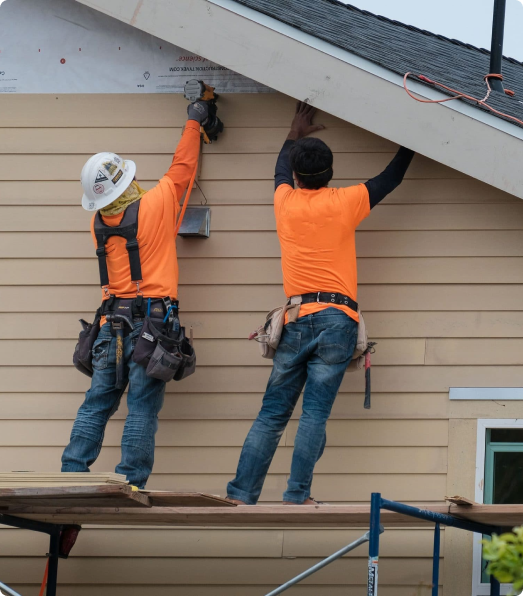
Correcting buckled vinyl siding requires removing and reinstalling courses without breaking the locks or cracking the panels. A zip tool unhooks the lock without damaging the hem, and knowing how much force a panel takes in 100 degree heat comes from doing it repeatedly. Attempting this without the right tool typically results in cracked panels and a larger repair than the one you started with. Our crews reinstall to manufacturer specification, with correct fastener depth, slot position, and clearance at every trim piece. The wall lies flat and stays flat through the following summer.
Matching material is its own skill set. Profile, color, and thickness all have to line up, and older discontinued lines require sourcing knowledge and sometimes creative relocation of existing panels. We handle color matching honestly, telling you up front when a perfect match is not realistic on aged siding. Pulling replacement panels from a rear or shaded elevation is often the better looking solution. Those decisions get made before work starts, not discovered halfway through.
Warranty protection depends on correct installation, and manufacturer coverage is voided by improper fastening on almost every product line. Our work carries a ten year workmanship guarantee alongside the lifetime manufacturer warranties available on qualifying materials. That combination means the repair is backed twice over. Insurance claims add another layer of complexity, and our claim specialists handle the documentation and adjuster coordination directly. We also apply $500 toward your deductible on qualifying claims. Dealing with storm damage on the roof as well? Click here for our roofing services.
Why Choose TM Roofing & Construction Group for Warped Vinyl Siding
We are locally owned and operated out of Bedford, and we work the same neighborhoods where our families live. That proximity means we know what a west facing wall in Hurst goes through in August and how a hail event in Grapevine tends to play out with insurance. More than 600 Facebook reviews and BBB accreditation reflect a record built one house at a time. We treat every home like our own, because more often than not the customer is a neighbor.
Our exterior work covers roofing, siding, and gutters, so problems that cross categories get solved in one pass. Free estimates come with no pressure, and flexible financing is available when a project is larger than expected. We are reachable 24/7, which matters when a storm rolls through overnight and you need someone on site. Insurance claim support is included rather than billed as an extra.
Warped and buckled vinyl siding will not correct itself, and every additional summer of heat cycling makes the underlying restriction worse. Getting an accurate diagnosis now costs nothing and often prevents a full elevation replacement later. Our team will tell you plainly which panels can be saved and which ones cannot. Call TM Roofing & Construction Group at (817) 820-9596 to schedule your free siding inspection, or click here to learn more about our siding services and how we protect North Texas homes from summer heat damage.