How Strong Winds Loosen Shingles Without Blowing Them Off
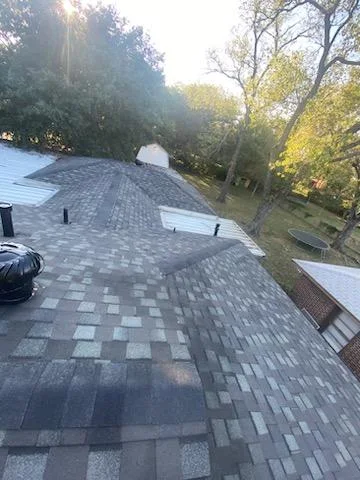
Wind damage on an asphalt shingle roof almost never looks the way homeowners expect it to look. Most people picture bare decking and shingle tabs scattered across the front lawn, but that level of visible loss only happens in the strongest gusts of the strongest storms. The far more common outcome across North Texas is a roof that looks completely normal from the driveway while dozens of shingles have quietly lost their grip on the course below them. Wind works by lifting the free bottom edge of a shingle, breaking the adhesive bond that holds it down, and then setting that shingle back into almost the exact position it started in. The fasteners stay in the deck, the shingle stays on the roof, and the damage stays invisible until a hard rain finds the opening that the wind created. Summer thunderstorms and the outflow winds that come with them produce these gusts across Tarrant and Denton counties several times every season. The shingles that survive one storm in a loosened condition are very often the same shingles that fail completely during the next one.
How Strong Winds Loosen Shingles on an Asphalt Roof
Wind does not push shingles off a roof so much as it pulls them upward. As air moves across a sloped surface it accelerates and separates, and that separation creates negative pressure, which is simply suction working against the roof covering. A properly sealed shingle presents almost no surface for that suction to act on because the bottom edge lies flat and tight. Once any part of that bottom edge lifts even slightly, the shingle begins acting like a small sail and the pressure underneath multiplies quickly. The uplift force concentrates at very specific areas of the roof, and it targets weaknesses in the sealant bond and in the fastening pattern long before it targets the field of the roof. Understanding these three failure points explains why a roof can take real damage during a storm and still look untouched from the ground the following morning.
The Sealant Strip Failure That Lets Strong Winds Loosen Shingles
Every asphalt shingle carries a factory applied strip of thermally activated adhesive across its surface. Heat from the sun softens that strip after installation, and the weight of the course above presses the two layers together until they fuse into one continuous sealed surface. That bond, and not the nails alone, is what holds the exposed bottom edge of each shingle flat against the shingle below it. The nails secure the shingle to the roof deck, while the sealant strip controls the only free edge that moving air can actually reach. When the bond has formed correctly across the full width of the strip, wind travels over the roof and finds nothing to grab onto. When that bond is weak, contaminated, aged, or never fully formed in the first place, the same wind gets underneath the tab and begins working it upward with every gust that passes over the house.
Sealant bonds fail for reasons that have nothing to do with the strength of any single storm. Shingles installed during cool or overcast weather may sit unbonded for weeks or even months until enough direct sun reaches the surface to activate the adhesive, and a wind event during that window will find an entire roof in a vulnerable condition. Slopes that face north, sit in heavy shade from mature trees, or stay cool under overhanging limbs frequently seal more slowly and less completely than the sunny slopes on the same structure. Dust, pollen, and loose granules that settle on the adhesive during installation reduce the surface area available for bonding, which produces a seal that looks acceptable but holds at a fraction of its intended strength. Foot traffic from other trades, satellite installers, and holiday decorating can break bonds without leaving any visible mark on the surface. Older roofs face a different problem entirely, because asphalt loses its volatile oils over years of heat exposure and the adhesive gradually becomes brittle and loses its tack. A roof past the fifteen year mark in this climate often has bonds that release under wind speeds far below anything the shingle was originally rated to handle.
The most important detail about a broken sealant bond is that it rarely repairs itself. Once a tab lifts and separates, dust and loose granules blow into the gap and coat the exposed adhesive, and contaminated adhesive does not reliably bond a second time. The shingle needs firm downward contact combined with sustained surface heat to reseal, and a tab that has been creased upward no longer sits flat enough to make that contact. Wind frequently leaves a horizontal fracture line across the shingle where it folded back on itself, and that crease permanently damages the fiberglass mat and the asphalt coating even after the shingle drops back into position. Water follows those fracture lines directly to the deck below. From the street the roof still reads as a clean, uniform surface, which is exactly why so much wind damage goes unreported until an interior leak forces the issue. Need a professional evaluation of your shingles after a storm? Click here for our roofing services.
How Strong Winds Loosen Shingles at Roof Edges and Corners
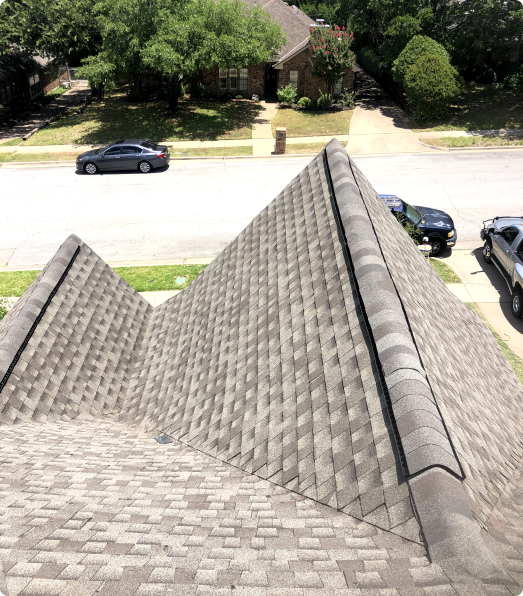
Uplift pressure is not distributed evenly across a roof, and the difference between zones is dramatic. Wind striking a house has to travel around and over the structure, and it separates from the surface at every sharp change in direction, which means eaves, rake edges, ridges, and hips carry far more suction than the broad middle of any slope. Corner zones, where two edges meet, routinely see uplift pressures several times higher than the field of the roof. This is why a wind damage inspection always begins at the perimeter and works inward rather than starting in the center. The first three feet along a rake edge and the first course along the eave absorb the majority of the punishment during a strong storm. On homes with tall gable ends, wide overhangs, or exposure to open ground on the windward side, those pressures climb higher still.
The starter course along the eaves and rakes carries an enormous share of the responsibility for keeping a roof intact. A proper starter strip has its own factory applied adhesive positioned near the outside edge, and it bonds the very bottom of the first shingle course down tight against the drip edge. Roofs built with cut shingles flipped upside down as starter, or roofs where the starter was set back too far from the edge, leave that first course with an unbonded free edge sitting directly in the highest pressure zone on the entire structure. Wind finds that edge immediately. Once the first course lifts, the second course loses its own support and the failure walks up the slope one row at a time. Drip edge metal matters here as well, because it gives the shingle edge a firm surface to seal against and keeps water from wicking back onto the fascia board. Missing or undersized drip edge leaves the eave soft and flexible, and flexible edges lift.
Ridge and hip caps deserve their own attention after any wind event. Cap shingles sit at the highest pressure line on the roof, they are bent over a peak that keeps them under constant tension, and they rely on a small bonding area to stay flat. Wind regularly breaks cap seals and lifts the exposed edges without carrying the caps away, which leaves the fasteners underneath partially exposed to weather. Those exposed nail heads rust, the holes elongate as the caps move in the wind, and water eventually follows the shanks straight down into the ridge opening. Homeowners looking up from the yard see an intact ridge line and assume everything is fine. An inspector standing on the roof sees caps that move under light hand pressure and fasteners that have already backed out of the deck.
Nail Placement Problems That Let Strong Winds Loosen Shingles
Fastening errors turn ordinary wind into damaging wind, and these errors are among the most common problems found on roofs that were installed quickly or by inexperienced crews. Every asphalt shingle has a designated nailing area marked on its face, and fasteners driven within that area pass through the shingle being installed and also catch the top edge of the shingle in the course below. That double layer capture is what gives the roof its holding power. Nails driven above the marked line miss the underlying course completely, which leaves that lower shingle held by nothing but its sealant strip. When wind breaks that seal, the shingle hinges freely and works its fasteners loose with every gust. High nailing is invisible from the ground and invisible from the finished surface, and it only reveals itself when a shingle is lifted during an inspection or when a section fails during a storm.
Drive depth creates a second set of problems that behave the same way. An overdriven nail cuts through the fiberglass mat and leaves the shingle held by a hole rather than by the head of the fastener, and wind pulls those shingles free with very little effort. An underdriven nail leaves the head standing proud above the surface, which lifts the shingle above it into a raised profile and eventually wears a hole through the back of that shingle as the two surfaces rub. Nails driven at an angle produce the same result on one side of the head. Roofs fastened with staples, which appear frequently on older Tarrant County homes, hold far less than round headed roofing nails and pull through the mat under moderate uplift. Each of these conditions leaves shingles technically attached but functionally loose. Wind exploits every one of them.
Fastener count matters just as much as fastener quality. Most asphalt shingles carry a standard four nail pattern for typical applications, and manufacturers require a six nail pattern to achieve their highest published wind ratings and to maintain warranty coverage in high wind regions. Published ratings such as one hundred ten miles per hour or one hundred thirty miles per hour describe laboratory performance under specific test conditions, and those numbers only apply when the shingle was installed exactly as the manufacturer specified and when the sealant strip has fully bonded. A four nail roof with partially sealed shingles performs nothing like the number printed on the wrapper. This gap between rated performance and installed performance explains why two houses on the same street can experience identical wind speeds and end up with completely different outcomes. The house with correct fastening and a full seal sheds the storm, while the house next door collects damage that nobody notices for months.
Signs Strong Winds Have Loosened Shingles Without Blowing Them Off
Loosened shingles leave evidence, but the evidence is subtle and most of it sits somewhere other than the roof surface itself. Homeowners who know what to look for can catch these problems from the ground and from inside the attic long before water reaches a ceiling. The signs tend to appear in a predictable order, starting with material shed into the gutters, moving to visual irregularities in the shingle courses, and finally showing up as moisture on the underside of the roof deck. Timing matters here because insurance policies contain reporting requirements and Texas law places limits on how long a claim stays viable. A short walk around the house after a storm, followed by a careful look in the attic, gives you the information you need to decide on a professional inspection.
Ground Level Signs That Strong Winds Loosened Shingles
Start at the gutters and downspouts, because that is where the roof deposits its first warning. Asphalt shingles shed granules gradually across their whole service life, but a sudden heavy accumulation of granules at downspout outlets and splash blocks after a wind event indicates surface abrasion and flexing. Wind that bends a shingle upward fractures the asphalt coating and releases granules in concentrated amounts, and the volume tells you something about how much movement occurred. Look for piles of dark sandy material in the gutter troughs and around the base of downspouts. Check the same locations again after the next rain to see if the shedding continues. Wind also pulls gutters away from the fascia and loosens hangers, which shows up as sagging sections, separated seams, or downspouts hanging free at the elbow. Storm winds that damage shingles very often damage the gutter system on the same elevation. Wind pull your gutters loose during the same storm? Click here for our gutter services.
Next, study the shingle courses themselves in low angle light, which means early morning or late afternoon when shadows exaggerate any irregularity in the surface. Sealed shingles produce clean, straight, unbroken horizontal lines across each slope. Loosened shingles break that pattern with raised corners, slight cupping at the bottom edge, tabs that sit a fraction higher than their neighbors, and shadow lines that waver instead of running straight. Look also for shingles that have shifted sideways or slipped downslope, since movement of any kind means the fasteners have been working in their holes. Dark or shiny streaks running horizontally across a course sometimes indicate exposed asphalt where the sealant strip tore apart. Exposed nail heads anywhere on the field of the roof, on the ridge, or around penetrations point to fasteners that have backed out under repeated flexing.
Finish the walk by inspecting everything around the roof rather than just the roof plane. Pipe boots, vent hoods, turbine bases, and flashing at wall intersections all rely on sealed shingles around their perimeters, and wind that loosens the surrounding shingles frequently breaks those details loose as well. Check the ground for small pieces of asphalt, fragments of shingle corners, or scattered granule clumps in the flower beds and on the patio. Look at fascia boards and soffit panels for separation, buckling, or fresh gaps that indicate pressure got underneath the roof edge. Damaged siding, bent metal, dented gutter aprons, and displaced fence sections on the same side of the house all confirm the direction the wind came from, which tells you which slope took the worst of it. Photograph everything you find with the date recorded, because that documentation supports any claim you decide to file later.

Attic Clues That Strong Winds Loosened Shingles
The attic gives you the clearest early evidence of a compromised roof, and checking it costs nothing but time and a flashlight. Go up on a dry, sunny day and scan the underside of the roof deck slowly, focusing on the areas nearest the eaves, rakes, ridges, and any penetration you can identify from below. Fresh water intrusion appears as dark staining on the wood sheathing, often in irregular patches that follow the grain or spread outward from a single point. Look closely at the nail shanks poking through the deck, since active moisture causes those shanks to rust and leaves rust rings on the surrounding wood. Run your hand across the insulation directly under the suspect areas and check for damp, matted, or compressed batts. A musty smell in an attic that previously smelled like dry wood is a reliable indicator that moisture has been present.
Daylight visible through the deck deserves immediate attention. Small pinpoints of light at nail holes are common and usually harmless, but a visible line, gap, or bright spot along a seam means the covering above has separated. Look at the ridge line specifically, since lifted cap shingles frequently open a light gap along the peak. Also examine the deck seams where two sheets of sheathing meet, because those joints move slightly and are the first places water stains show up. Bring a bright light and take your time working across the full length of the roof rather than checking only the section closest to the access hatch. Damage from a single storm often affects only one slope, and that slope may sit at the far end of the attic where nobody has looked in years.
Understand that interior evidence lags behind the actual damage by a significant margin. Water that enters through a loosened shingle first has to soak the underlayment, then find a fastener hole or a seam, then saturate the decking, and only after that does it travel far enough to stain drywall. Underlayment provides genuine secondary protection, but it is a temporary barrier rather than a permanent roof, and asphalt saturated felt degrades quickly once it stays wet. This delay is precisely why so many homeowners discover storm damage months after the storm that caused it, at which point the connection between the two becomes harder to establish with an insurance carrier. A ceiling stain in November very often traces back to an August wind event. Checking the attic within a few days of any significant storm removes that guesswork entirely and gives you a documented starting point.
What a Roof Inspection Finds After Strong Winds Loosen Shingles
A professional wind damage inspection tests the roof rather than simply looking at it, which is the difference that matters most. An experienced inspector works slope by slope and lifts shingles by hand across representative sections of each one, feeling for the resistance a properly bonded sealant strip provides. Shingles that release with almost no effort have already lost their bond, and the pattern of those failures across a slope tells the inspector how the wind moved across the structure. The inspector checks fastener placement by exposing the nail line on selected shingles, which reveals high nailing, overdriven heads, missing fasteners, and staples in one look. Creases receive careful attention because a fold across the mat is permanent damage even when the shingle lies flat afterward. Every finding gets photographed with location detail so the documentation stands on its own.
The inspection covers far more than the shingle field. Ridge and hip caps get hand tested for movement, flashing at walls and chimneys gets checked for lifted or displaced sections, and pipe boots get examined for cracked collars and loosened bases. Valleys receive close attention since they carry concentrated water volume and show failure quickly once the surrounding shingles loosen. The inspector also evaluates the gutter system, drip edge, fascia, soffit, and any siding on the affected elevations, because wind damage rarely limits itself to a single component. Ventilation gets assessed at the same time, since poor attic airflow accelerates shingle aging and weakens sealant bonds across the entire roof. The result is a complete picture rather than a spot check.
That documented picture is what determines your options going forward. Isolated damage confined to one slope or one section often calls for targeted repair, and repairing early prevents a small problem from spreading across the roof. Widespread seal failure, extensive creasing, or a roof already near the end of its service life points toward replacement as the more economical decision over any reasonable time horizon. A written inspection report with dated photographs also becomes the foundation of an insurance claim, and carriers respond very differently to organized evidence than they do to a general complaint about a storm. Knowing exactly what condition your roof is in puts you in control of the timeline instead of leaving you reacting to the next leak. That knowledge costs nothing when the inspection is free.
Why You Need a Wind Damage Roof Inspection After Strong Winds Loosen Shingles
A roof with loosened shingles is a roof operating without its primary defense, and the next storm does not need to be a strong one to cause real damage. Every additional wind event works the compromised areas further, widens the openings, and drives more water underneath the covering. What starts as a handful of broken seals along one rake edge becomes a saturated deck, stained ceilings, ruined insulation, and eventually structural repair that costs many times what the original fix would have. North Texas gets its share of severe weather from spring through early fall, which means the window between storms is usually short. A free inspection after any significant wind event turns an unknown into a known and gives you time to act on your own schedule.
Why Waiting Costs More After Strong Winds Loosen Shingles
Roof damage compounds in a way that few other home repairs do, because every day of exposure adds to the total. Water that reaches the decking swells the wood fibers, weakens the plywood, and eventually requires sheet replacement rather than simple recovering. Saturated insulation loses its performance value permanently and raises cooling costs through the hottest months of the year. Wet framing and trapped moisture also create conditions for mold growth in an attic that stays warm and dark, which introduces air quality concerns and remediation expenses on top of the roofing work. Addressing loosened shingles while the problem is still limited to the covering keeps the repair simple and the cost predictable.
The financial gap between early and late action is significant. Repairing a section of loosened shingles, replacing damaged starter, and resealing an edge is straightforward work that a qualified crew completes in a single visit. That same area left alone through a full storm season frequently turns into decking replacement, interior drywall repair, insulation removal, and paint work across multiple rooms. Homeowners who wait also lose flexibility, because emergency repairs happen on the weather’s schedule rather than on theirs. Getting ahead of the problem keeps you in a position to compare options, review financing, and choose materials without pressure.
There is also a resale consideration that homeowners often overlook until it becomes urgent. Buyers order inspections, inspectors find loosened shingles and creased tabs, and those findings turn into repair demands or price reductions during negotiation. Unrepaired storm damage discovered at closing time gets fixed under deadline pressure at whatever price is available. A roof addressed properly and documented with an inspection report and warranty paperwork becomes a selling point instead. Handling it now protects both the structure and the value of the property.
How Insurance Claims Work When Strong Winds Loosen Shingles
Most homeowner policies in Texas cover sudden wind damage, and broken sealant bonds combined with creased shingles qualify as physical damage under the terms of a standard policy. Carriers do draw a firm line between storm damage and gradual wear, which is why documentation and timing carry so much weight. An inspection performed soon after a storm establishes both the condition and the date, and dated photographs of creases, lifted tabs, and displaced fasteners connect the damage to a specific weather event. Policies also contain reporting requirements, and waiting through months of additional weather makes it far harder to demonstrate what any single storm caused. Filing promptly protects your position.
Knowing what your policy actually says before you file makes the process much smoother. Some policies pay replacement cost value while others pay actual cash value on roofs, and that difference determines how much of the total you receive up front. Deductibles on wind and hail losses are frequently calculated as a percentage of the dwelling coverage rather than as a flat amount, which surprises many homeowners at exactly the wrong moment. Certain policies also carry cosmetic damage exclusions that affect metal components. Reading your declarations page before the adjuster arrives puts you in a much stronger position throughout the process.
Having an experienced roofing contractor present during the adjuster inspection benefits everyone involved. A contractor who works on these roofs every day identifies loosened shingles, high nailing, damaged starter, and compromised flashing that a general inspection can easily miss on a roof that looks intact. That contractor speaks the same technical language as the adjuster and can point to specific evidence on specific slopes. The goal is a complete and accurate scope of the actual damage, documented clearly the first time through. Accuracy at that stage prevents supplement disputes and delays later on.
Why Choose TM Roofing & Construction Group for Wind Damaged Shingles
TM Roofing & Construction Group is locally owned and operated out of Bedford, and we work on roofs across Tarrant and Denton counties every week of the year. More than six hundred Facebook reviews and our BBB accreditation reflect how we handle both the work itself and the conversations around it. We install to manufacturer specification, which includes correct fastener placement, proper starter application at eaves and rakes, and the high wind nailing patterns required to maintain full warranty coverage. Our work is backed by lifetime manufacturer warranties on materials and a ten year workmanship guarantee on our installation. We treat every house the way we would treat our own.
Our team specializes in insurance claims and understands how carriers evaluate wind damage on asphalt shingle roofs. We document conditions thoroughly, meet adjusters on site, and make sure the scope reflects everything the storm actually affected across the roof, the gutters, and the siding. Flexible financing is available for homeowners handling repairs outside of a claim or covering costs beyond what a policy pays. Estimates are always free, and we are available around the clock when a storm creates an urgent problem. You get straight answers about what your roof needs and what it does not.
Storm season in North Texas does not wait for a convenient time, and neither should your inspection. If recent winds have moved through your neighborhood, get your roof evaluated before the next system arrives and turns a handful of loosened shingles into an interior repair. Call TM Roofing & Construction Group at (817) 820-9596 to schedule your free inspection, and we will give you a clear written assessment of exactly what we find. Wind damage that gets caught early stays small and stays affordable. Ready to protect your home from the next storm? Click here for our roofing services.